Imagine you're ten miles deep into the backcountry. No cell service. No towers. Just you and the wilderness. Now imagine you can send a text message, share your GPS coordinates, and coordinate with your team using a device that costs less than a fancy dinner.
This is Meshtastic. It's not just a gadget - it's a revolution in off-grid communication. While the world relies on massive corporate towers, a new movement is building a people's network: a decentralized mesh that belongs to no one and everyone.
What Is Meshtastic?
Meshtastic is an open-source, decentralized mesh networking platform that runs on inexpensive LoRa radio hardware. In plain English: it lets you send text messages and GPS coordinates over long distances without any cell towers, internet, or infrastructure.
It's like a walkie-talkie, but for text. And it works at distances that would make a walkie-talkie weep.
How the Mesh Works
In a traditional network, your phone talks to a tower. If the tower goes down, you're offline. That's a hub-and-spoke model, and it's fragile by design.
A mesh network is different. Every single device is a router. If I send a message to someone five miles away, my device doesn't need to see them directly. It just needs to see someone who can see someone who eventually sees them. The message hops across the network until it reaches the target.
This is powered by LoRa - Long Range radio. Unlike WiFi, which is fast but short-range, LoRa is slow but incredibly hardy. It's designed for small packets of data - text, GPS, and simple telemetry - that can travel miles through forests and concrete.
The Hardware: Three Paths In
You don't need a degree in electrical engineering to do this. There are three main paths you can take:
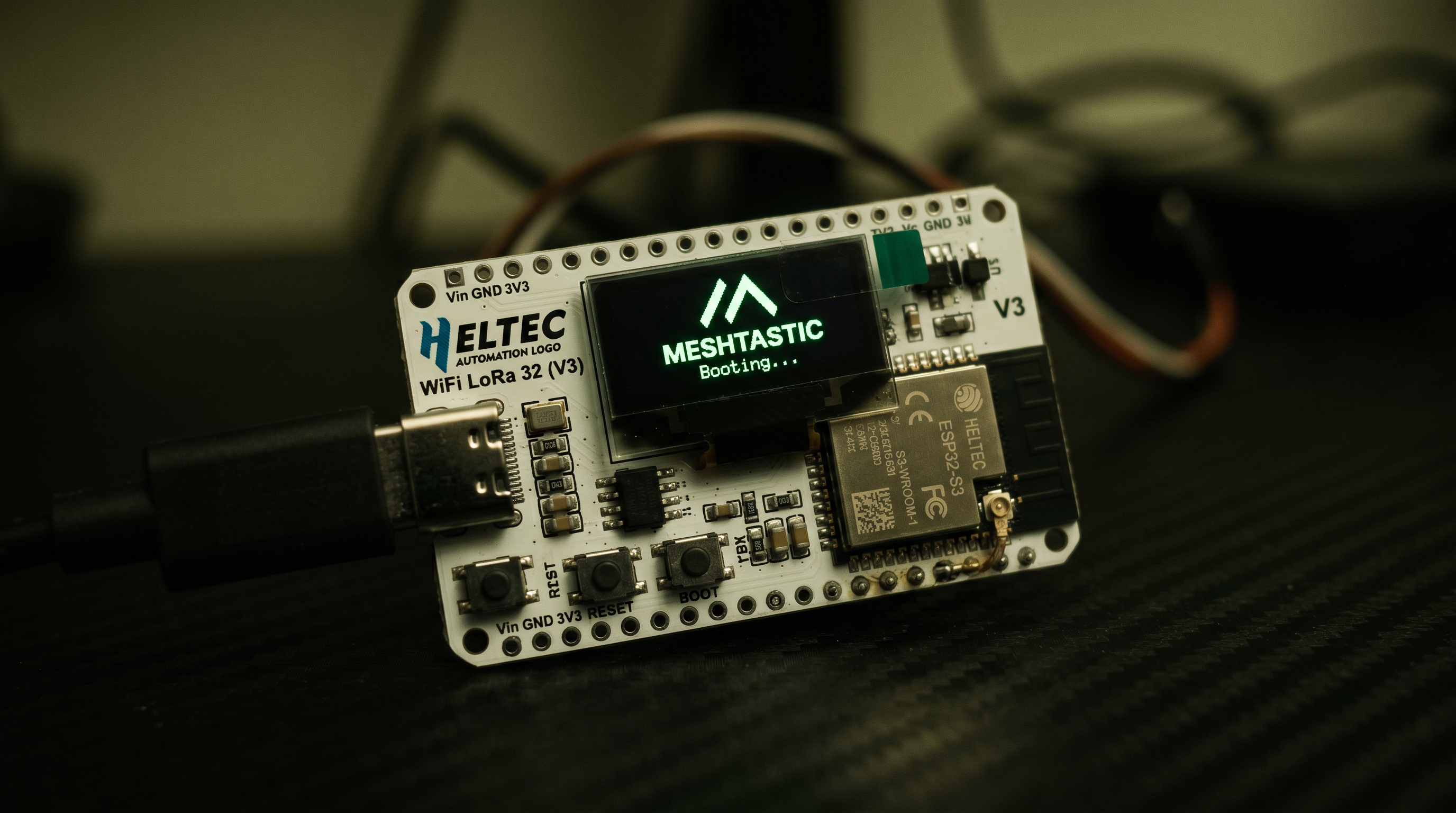
1. Heltec V3 (~$25-35)
The gold standard for beginners. It's cheap, has a built-in OLED screen, and is supported by almost every tutorial. It's the plug-and-play option for most people. USB-C, built-in WiFi for firmware updates, and the screen shows you what's happening without needing to check your phone.
2. Lilygo T-Beam (~$30-40)
Its superpower? GPS. If you're using this for hiking or search and rescue, the T-Beam is your best bet because it integrates location data natively. It also has a slot for an 18650 battery, so you can run it for days on a single charge.
3. Rak WisBlock (~$40-60)
For the pros. These are modular and incredibly power-efficient. If you're building a solar-powered node to sit on a mountain for six months, you buy a Rak. They sip power and the modular design means you only buy what you need.
Getting Started: Three Steps
Getting started is a three-step process. Simple enough:
Step 1: Flash the Firmware
Most devices come with some software pre-installed, but you'll want the latest Meshtastic build. This is usually a simple web browser flash - no coding required. Plug the device into your laptop via USB-C, go to the Meshtastic flasher website, select your board, and click "Flash." That's it.
Step 2: Pair via Bluetooth
The radio does the heavy lifting. Your phone is just the keyboard and screen. Open the Meshtastic app, scan for nearby devices, and pair. The app handles the rest.
Step 3: Join a Channel
By default, every device is on the LongFast channel. This is the public square. Everyone in your area can see these messages. But you can also create private encrypted channels for your family or your team. AES-256 encryption, for anyone who cares.
Is It Perfect?
No. It's slow. You aren't sending 4K videos over Meshtastic. But in a world where the grid is fragile, having a communication method that requires zero infrastructure is a superpower.
Here's the thing nobody tells you: the mesh gets stronger with every node. One device is useful. Two is a conversation. Ten is a network. A hundred is a community that can't be shut down.
What You'll Need
- A Meshtastic-compatible board - Heltec V3 is my recommendation for most people
- A USB-C cable - for flashing firmware
- The Meshtastic app - available for iOS and Android
- A battery - most boards run on 3.7V LiPo or 18650 cells
- An antenna - the stock one works, but a better antenna is the single biggest upgrade you can make
The Verdict
Meshtastic is the cheapest, most accessible entry point to off-grid mesh networking that has ever existed. For $40, you get encrypted, decentralized text messaging that works where cell phones don't. That's not a gadget - that's a capability.
Too long, didn't read: Buy a Heltec V3, flash the firmware, pair it to your phone, and join the LongFast channel. You'll be on the mesh in under 30 minutes. Set it up before you need it. Let me reiterate: set it up before you need it. Once you need it, it's too late to coordinate the setup.
Links to the best budget boards and antennas are in the description of the video. If this helped you understand the mesh, hit that subscribe button. We're diving deep into Reticulum and GMRS in the next few videos.
Stay private. Stay connected. I'll see you on the mesh.